Internet and Psychiatry
  • Home
    • Editorials
    • Research news
    • Research papers
    • Interviews with eminent psychiatrists
    • Ten years ago
    • Fifteen years ago
  • Topics
    • Alcohol and Drug Abuse
    • Anxiety Disorders
    • Biomedical Science
    • Compulsive gambling
    • Disaster Medicine
    • Education
    • General Medicine
      • Acupuncture
      • Physical medicine and Rehabilitation
    • Human Rights
    • Interviews with eminent psychiatrists
    • Mood Disorders
      • Bipolar Disorder
      • Depression
      • Seasonal Affective Disorder
    • Neurological Disorders
    • Other Psychiatric Disorders
    • Posttraumatic Stress Disorder
    • Sexual Behavior
  • Books
    • Comorbidity of Depression and Alcohol Use Disorders
    • “Immigration and Mental Health” chapter abstracts
    • “Internet and Suicide” chapter abstracts
    • “Neurobiology of PTSD” chapter abstracts
    • “Suicidal Behavior in Alcohol…” chapter abstracts
    • “Suicide in the Military” chapter abstracts
    • “Terror and Suicide” chapter abstracts
    • “War and Suicide” chapter abstracts
  • Editors
    • Leo Sher, M.D.
    • Alexander Vilens, M.S.
  • Guests
    • Distinguished Guests
    • Our Contributors
  • Reflections
    • Poetry
    • Quotes

Editorials

The weekly distribution of suicides in Japan

May 12, 2010

Masahito Fushimi, M.D., Ph.D.

The article by Dr. Sándor Kalmár, “The weekly distribution of suicides in Bács-Kiskun County, Hungary” is interesting. I would like to make some comments on this article.

First, it is interesting that there are similarities between the methods of suicide used in Akita Prefecture (Japan) and in Bács-Kiskun (Hungary). As in Bács-Kiskun (Hungary), the most common method of suicide both in the whole of Japan and in Akita Prefecture is by hanging oneself. As to why many suicides do so by hanging themselves, it may be because in Japan, “hanging” is strongly associated with the death penalty. Moreover, gun possession is prohibited in principle by the Japanese law; as such, there are only a few suicides where a firearm is used.

In addition, the economy of both Akita Prefecture and Bács-Kiskun is primarily based on agriculture. In other words, Akita Prefecture is quite rural. Therefore, there are few high-rise buildings and the public transportation network (e.g., subways) is limited. Consequently, few suicides in Akita Prefecture do so by “jumping from a height” and “jumping in front of a coming vehicle.” Further, as in Bács-Kiskun, in certain settlements of Akita Prefecture, it can be said that hanging themselves is almost the only method used.

The trend of the weekly distribution of suicides shown by Dr. Kalmár, especially those in recent years, is similar to that of the weekly distribution of suicides in Akita Prefecture; this is interesting. Dr. Kalmár noted in his article that the factors influencing the weekly distribution of suicides in his county are not medical but first of all social ones. I agree with his opinion. However, social and medical factors cannot be separate: they are related. For example, on the hypothesis that people tend to sleep until late morning on a holiday, the trend is a social factor. However, because of this trend, the number of people who will be witness to the break of dawn on a holiday decreases. Therefore, it is possible that people may get influenced by their biological rhythms or hormonal changes (patterns), which are medical (biological) factors. Consequently, I think that it is necessary to consider both social and medical (biological) factors.

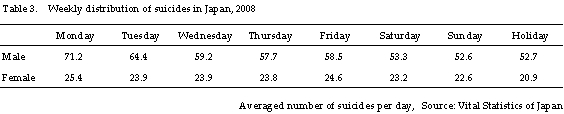
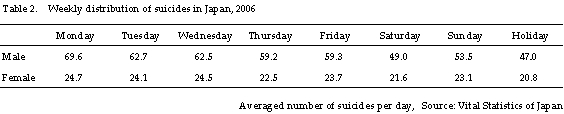
The Japanese government has released the data on the weekly distribution of suicides. The data are as follows:
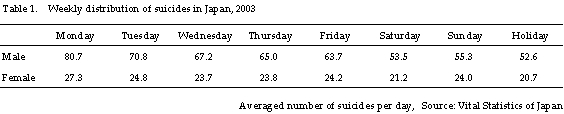
Weekly distribution of suicides in Japan, 2003

Weekly distribution of suicides in Japan, 2006

Weekly distribution of suicides in Japan, 2008

Related articles

  1. Sándor Kalmár: The weekly distribution of suicides in Bács-Kiskun County, Hungary.
  2. Masahito Fushimi: The weekly distribution of suicides in Akita Prefecture, Japan.

Related Posts

Editorials /

The role of the h-index in academic medicine

Editorials /

A timeless commitment: Reflections on the Hippocratic Oath

Editorials /

Abraham Flexner history: Celebrated medical educator – improved physician training, yet also left a not well-known legacy  

‹ Stressful politics: voters’ cortisol responses to the outcome of the 2008 United States Presidential election › Complex System Theories are necessary for a better understanding of our biopsychosociocultural constitution

Editorials

  • The role of the h-index in academic medicine
  • A timeless commitment: Reflections on the Hippocratic Oath
  • Abraham Flexner history: Celebrated medical educator – improved physician training, yet also left a not well-known legacy  
  • Suicide medical malpractice: A conceptual perspective

Research Papers

  • COVID-19 mortality in Europe and the ’Iron Curtain’ between East and West
  • Examination of depressive signs and symptoms among 803 University students in seven Universities and Colleges. Hungary, Romania, Serbia.
  • Examination of spirituality and the dimensions of spirituality among 803 students in seven different Universities. Hungary, Romania and Serbia.
  • Examination of depressive signs and symptoms among 932 students in eight different secondary schools in Hungary

Research News

  • Blood alcohol concentration and suicide mortality in Finland
  • Suicide risk in older adults: clinical responsibilities and medico-legal considerations
  • Conceptualizing a combat veteran’s suicide death through the stress-diathesis model
  • No evidence of a causal link between glucagon-like peptide-1 receptor agonists and suicidal behavior

Latest News

  • FDA launches real-time clinical trial initiative
  • The 2025 ScholarGPS rankings of leading scholars in suicidology
  • Mental health support for healthcare professionals
  • The 2024 ScholarGPS ranking of scholars in the field of suicidology

Interviews with eminent psychiatrists

  • 2026 Interview with Professor Zoltan Rihmer
  • 2026 Interview with Doctor María Dolores Braquehais Conesa
  • 2026 Interview with Professor Shih-Ku Lin
  • Interview with Professor Jess G. Fiedorowicz

Ten Years Ago

  • Suicide malpractice
  • Testosterone levels and future suicide attempts in women with bipolar disorder
  • Bipolar disorder, testosterone administration, and homicide
  • The cosyntropin stimulation test in military veterans with or without posttraumatic stress disorder

Back to Top

  • About
  • Contact
  • Privacy Policy
  • Terms and Conditions
Copyright © 2025 AVCalc LLC. All rights reserved worldwide.